Objects / Free essay · 2026-10-20
The Blue Hippo Carries More Than a Pattern
William’s lotus-covered body is at once an animal, a landscape and a repaired object. Its friendliness is the beginning of a reading, not the end.
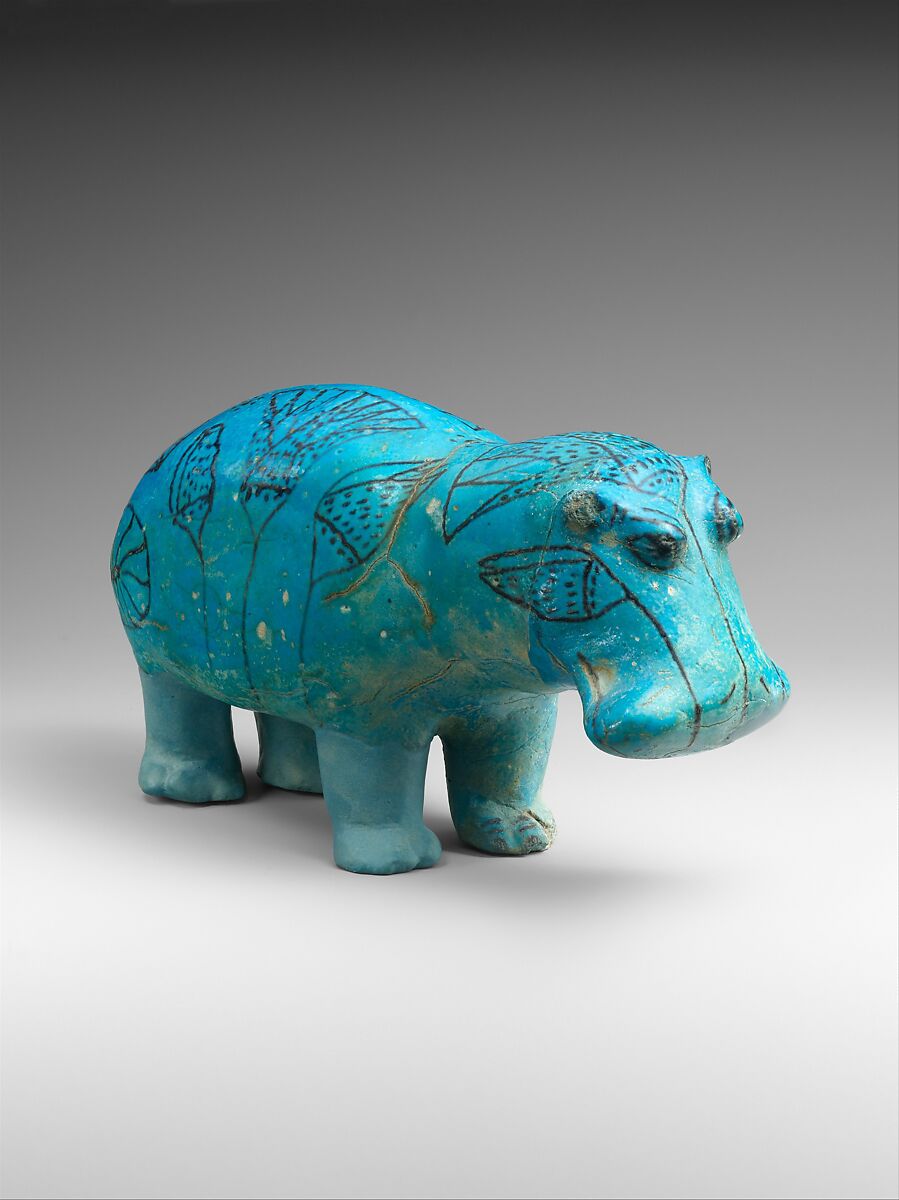
A lotus flower spreads across the side of a blue hippopotamus. The animal is small enough to become an affectionate possession in the imagination, but its decoration gives it something larger to contain: a fragment of river habitat. In the Met’s photograph, the black lines refuse to follow the body as anatomical markings. They establish a second image across the first.
The object is the faience hippopotamus now nicknamed William, accession 17.9.1. The Met dates it to about 1961–1878 BCE and records a length of 20 centimetres. Its provenance places it in a burial at Meir. Those facts do not make the image less approachable. They do make “a charming blue animal” an incomplete description of what it was made to do.
Look at the difference between silhouette and drawing. The broad back, projecting muzzle and short legs give the animal its compact identity. Across that volume, plants grow in thin dark lines. The surface does not imitate an animal’s skin in a straightforward naturalistic sense. Our reading is that the hippo carries its environment as an image, rather than merely standing within a depicted landscape.
That compression is an economical design decision. A separate marsh scene would require another surface or a larger setting. Here, habitat and creature occupy the same object. It is possible to recognise the heavy animal almost instantly, then spend much longer following the finer botanical shapes. The object rewards two different speeds of looking.
The blue is equally active. It makes a continuous visual field in which the black plants remain distinct. The colour can feel playful to a modern viewer, but that response is not historical evidence. The collection record connects the lotuses with renewal and the animal with danger as well as regenerative power. Enjoyment is a starting point; it should not decide the whole interpretation.
There is a sharper contradiction below the body. The Met identifies three legs as restorations and says they were probably deliberately broken to prevent the animal harming the deceased. Preserve that “probably”. The broken condition and the explanation offered for it are different kinds of statement. We can discuss the interpretation without pretending to have witnessed the act.
A complete-looking animal can therefore conceal an important disruption. Restoration makes the outline easier to grasp, yet the outline is not a neutral recovery of everything the object has been. The museum’s audio account explicitly draws attention to differences between the restored legs and the surviving one. Looking downwards changes the encounter: the little figure begins to carry a history of being restrained and remade.
This is not an argument that restoration is inherently deceptive. It is an argument for letting repair remain part of the description. A repaired object can present its form clearly while also retaining the questions created by damage. The trouble begins when a smooth visual encounter is treated as proof of an uninterrupted material history.
The 2017 conservation study by Anna Serotta, Carolyn Riccardelli and Debbie Schorsch offers a second interruption. They describe a silica-rich faience body and glaze rather than ordinary clay. Their examination considered more than one possible glazing process and did not settle every manufacturing question. Technical investigation makes the object more specific without making it fully explained.
That uncertainty matters to criticism. It would be tempting to read the fluent plant lines and confident volume as signs of an entirely effortless process. The conservators describe a difficult-to-work paste and ask how a figure of this size was formed. An assured appearance can be the result of demanding material decisions, including decisions that we can no longer reconstruct.
Their imaging and analysis also disclosed restoration and manufacturing features that ordinary viewing could not establish. We link that account for its evidence; we do not reproduce its laboratory photographs here or claim to diagnose a material from our own screen. The public-domain object photograph supports visual observations of pattern and volume, not an independent conservation report.
William’s modern nickname adds another layer. The collection record traces it to a 1931 humorous story involving a family and a colour print. An ancient object can acquire a modern social life through reproduction. The name makes it easier to address the animal as a companion, but the familiarity belongs to that later reception rather than to the original burial.
The critical risk is that affection becomes an instruction to stop asking. Once an object is a mascot, a viewer may feel they already know it. The floral surface, repaired support and uncertain making suggest otherwise. Familiarity can help us return to an object; it should not turn the return into automatic recognition.
Try looking in three passes. First ignore the plants and follow the animal’s outline. Next read the black drawing without mentally filling in a river scene. Finally look at the legs and consult the conservation link. Each pass produces a different object: a recognisable creature, a patterned field and a material survivor. None is sufficient alone.
The blue hippo’s achievement is not that it reconciles all those identities into a simple symbol. It holds them close enough to trouble one another. An animal can be appealing and dangerous; a surface can describe a habitat and carry a history of making; a complete silhouette can depend on modern repair. Its charm becomes more interesting when it stops being the conclusion.
Published 20 October 2026. Original criticism based on the museum’s records and digital reproductions, not a firsthand visit or examination. Interpretations of rhythm, compression and reception are ours. Museum display information may change; the historical collection record is not a guarantee of access.
Sources & further reading
- The Met — Hippopotamus (William), 17.9.1: current catalogue, date, burial context, lotuses, restored legs and modern nickname. https://www.metmuseum.org/art/collection/search/544227
- Anna Serotta, Carolyn Riccardelli and Debbie Schorsch — Getting to Know William—Inside and Out, 24 October 2017: material, imaging, restoration and unresolved manufacturing questions. https://www.metmuseum.org/perspectives/william-hippo-conservation
- The Met — Egyptian Art, Bulletin 41/3, Winter 1983–84: historical curatorial interpretation and further reading. https://resources.metmuseum.org/resources/metpublications/pdf/Egyptian_Art_The_Metropolitan_Museum_of_Art_Bulletin_v_41_no_3_Winter_1983_1984.pdf
- The Met — Open Access policy and image use. https://www.metmuseum.org/about-the-met/policies-and-documents/open-access
Source records checked 2026-10-20. Original editorial text by Odd Index; image rights are stated in the caption.
Read next
 Material Histories · Free to read
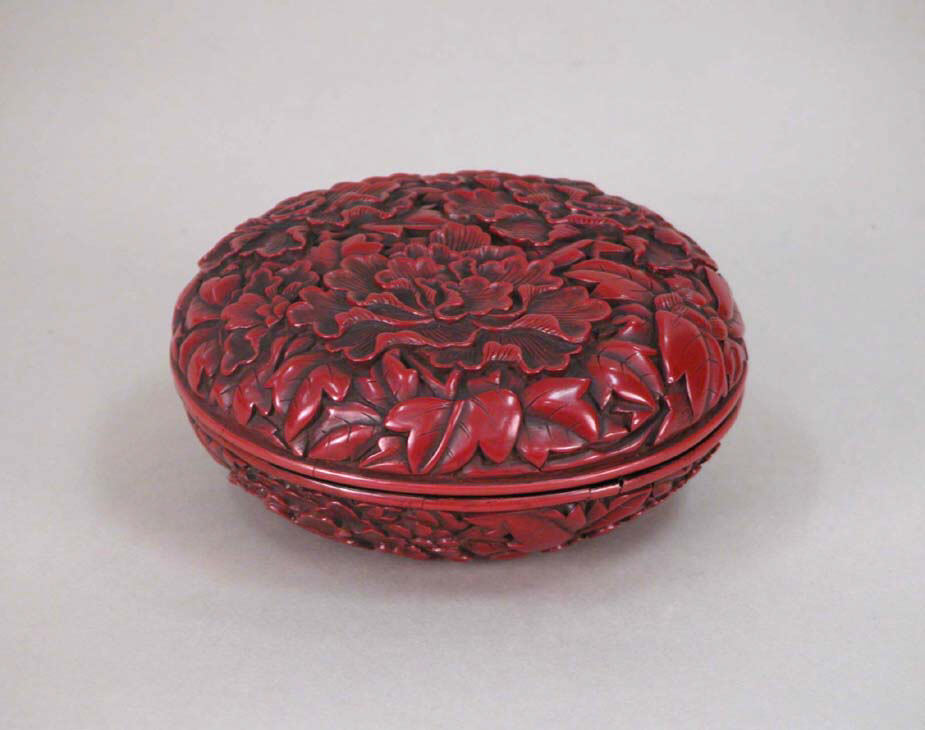
Lacquer: A Surface Made of Time
A carved red box reveals why a finish is not merely the last step: building a surface can create the material from which ornament is cut.
Read the essay ↗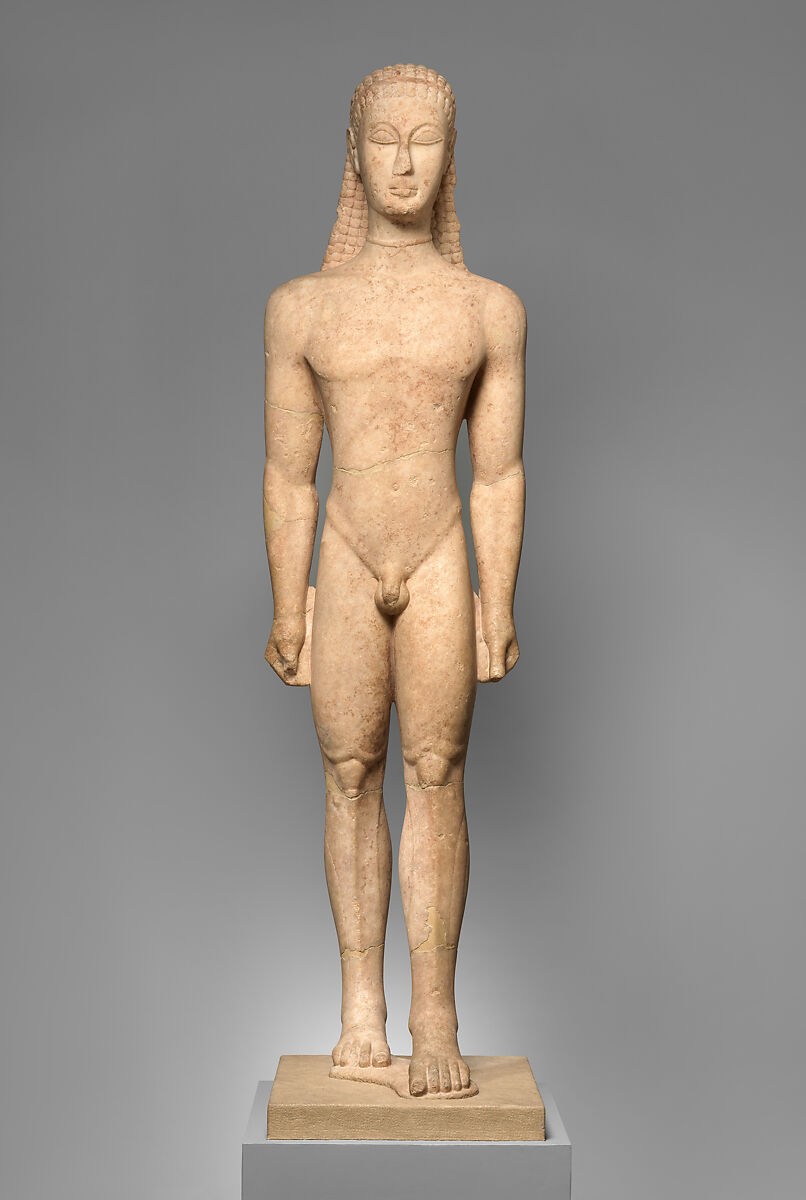 Objects · Free to read
One Foot Forward, Still Holding Ground
The Met’s early Greek kouros proposes a step without taking one. Its stillness is a design decision with commemorative and social consequences.
Read the essay ↗Dossier · Member previewFrom Object to Argument: A Research Workbook
A reusable method for investigating gardens, dress and materials: source records, competing explanations and three worked research plans.
Read the preview ↗