Objects / Free essay · 2026-10-18
One Foot Forward, Still Holding Ground
The Met’s early Greek kouros proposes a step without taking one. Its stillness is a design decision with commemorative and social consequences.
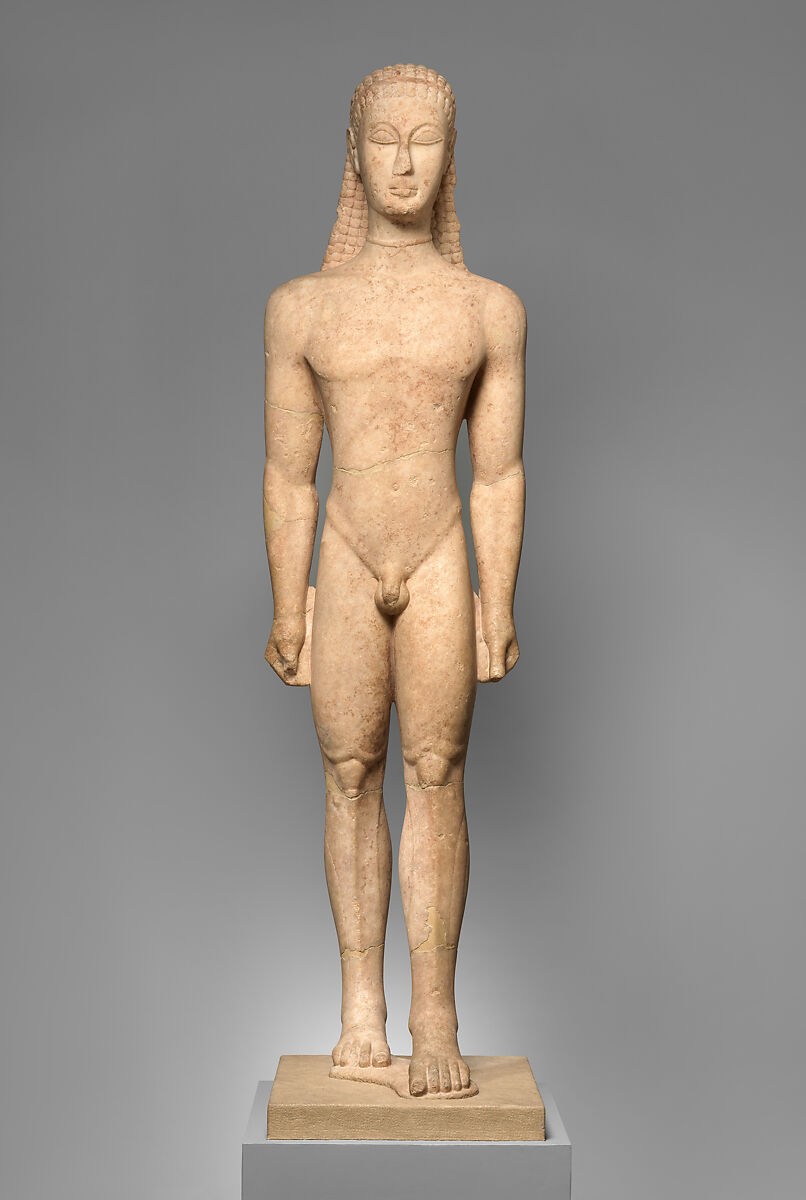
The left foot is ahead, but the figure is not going anywhere. In the Met’s frontal photograph of its marble kouros, the separated feet suggest a step while the rest of the body keeps a firm appointment with the vertical. Arms hang close to the sides. The face addresses the space in front. Movement has been proposed and then held open.
The museum dates the Attic sculpture to about 590–580 BCE and identifies its material as Naxian marble. At roughly 1.95 metres tall, it is larger than many of its viewers. The record says it marked the grave of a young Athenian aristocrat. That purpose changes the apparent contradiction between stepping and remaining: a body represented in lasting stone is being asked to hold a place for somebody absent.
Look first at the knees. Their articulated shapes do not simply disappear into the legs as they might in a distant photograph of a living person. They announce themselves as decisions. The same is true of the abdomen, where shallow divisions organise the surface without making it feel soft. Anatomy is offered as an arrangement that can be read.
The hair introduces a different rhythm. Small repeated units frame the face and descend towards the shoulders. Set against the broad chest, they make the head feel both emphatic and contained. Our reading is that the sculptor uses repetition to establish order, then lets the larger unbroken areas of the body give that order room to register. Detail and blankness need one another.
Calling the result stiff is easy. Treating stiffness as a failure is less convincing. The figure does not offer the casual asymmetry of somebody interrupted halfway through a walk. It gives the viewer a stable encounter. The forward foot matters because it is a controlled difference inside an otherwise insistent arrangement, rather than the start of an unfolding action.
The Met connects the stance to Egyptian art. Its broader account of the Archaic period describes kouroi and korai in sanctuaries and cemeteries, serving religious dedications and commemoration. Those contexts warn against reading this body as a purely independent experiment in anatomical observation. A recognisable sculptural formula could carry social work as well as visual invention.
There is a danger in making the statue merely an early rung on a ladder towards later Greek naturalism. That story asks us to reward it for what it almost achieves. It also trains us to overlook what it already does with unusual force: establishing a body as a legible, persistent presence without relying on an instant of action.
The forward foot makes that problem especially clear. Cover the lower legs in the reproduction and the torso becomes almost a sign of standing. Reveal them again and the difference between the feet returns. The sculpture can introduce direction without surrendering its frontality. That is a compositional achievement, even if walking convincingly was never the point.
But admiration for formal coherence should not erase the commission’s social setting. The museum’s account identifies an aristocratic grave; its historical essay describes the costly funerary monuments erected by Athenian elite families. A beautiful generalised youth can commemorate a particular death while also making a family’s resources visible. Endurance is an aesthetic effect and a social claim.
The face gives us little basis for inventing an individual temperament. The museum’s educational resource distinguishes this ordered human image from a necessary likeness of one person. We should therefore resist assigning confidence, innocence or an inner monologue to its expression. A viewer may feel addressed without having recovered the subject’s psychology.
Nor is the present pale surface a complete account of the original encounter. The Met’s Roman Portraits catalogue notes surviving traces of paint on this kouros, including the eyes and hair. We reproduce the object as photographed now and offer no speculative recolouring. The relevant point is a limit: today’s marble colour should not silently become an ancient design principle.
A frontal image has its own limitations. It privileges the order described here while compressing depth, scale and the experience of moving around the stone. The collection record links additional views. Compare them before deciding that symmetry tells the whole story. This essay is based on those institutional records and digital images, not a recent gallery visit or physical examination.
Try three passes: read the hair as repeated units; follow the large surfaces between those units; then return to the uneven positions of the feet. Ask how much difference the figure needs to suggest a living presence. The answer need not be more detail. It may be a carefully rationed departure from repetition.
The kouros is compelling because it makes permanence visibly difficult. One foot promises direction, a frontal body holds its ground, and a grave marker stands in for a life that cannot resume. Its stillness has work to do. We lose that work when we see only an imperfect attempt to walk.
Published 18 October 2026. Original criticism; historical identifications follow the linked museum records. Interpretations of rhythm, presence and social tension are ours. The museum’s current display listing is not a guarantee of access on a future date.
Sources & further reading
- The Met — object record, date, material, dimensions, grave-marker identification, Egyptian-derived pose and Open Access image. https://www.metmuseum.org/art/collection/search/253370
- The Met — Greek Art in the Archaic Period, 1 October 2003: dedication and funerary contexts. https://www.metmuseum.org/essays/greek-art-in-the-archaic-period
- The Met — Greek Art: A Resource for Educators, October 2000: ordered form and the distinction from individual likeness. https://www.metmuseum.org/-/media/files/learn/for-educators/publications-for-educators/greek.pdf
- The Met — Roman Portraits: Sculptures in Stone and Bronze, discussion of kouros 32.11.1 and surviving pigment. Further reading. https://resources.metmuseum.org/resources/metpublications/pdf/Roman_Portraits_Sculptures_in_Stone_and_Bronze.pdf
- Image licence and source history: Met CC0 photograph. https://commons.wikimedia.org/wiki/File:Marble_statue_of_a_kouros_(youth)_MET_DT263.jpg
Source records checked 2026-10-18. Original editorial text by Odd Index; image rights are stated in the caption.
Read next
 Objects · Free to read
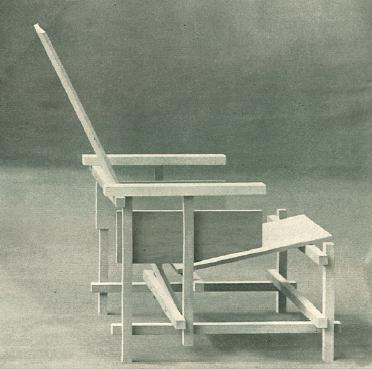
The Chair That Wants to Be Looked At
Rietveld's Red Blue Chair makes a useful starting point for asking what we expect furniture to do.
Read the essay ↗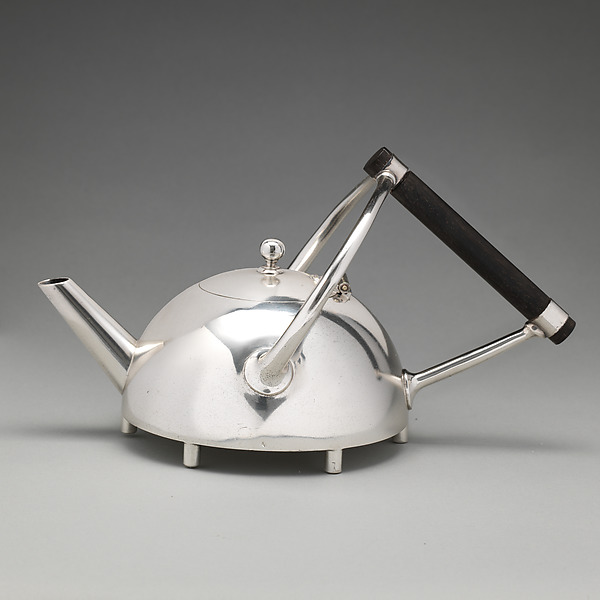 Objects · Free to read
The Teapot That Makes Pouring Look Like Engineering
Christopher Dresser’s silver-plated teapot turns handles, joints and empty space into an argument about design.
Read the essay ↗Visual culture · Free to readHow to Read a Museum Label Without Losing the Artwork
Separate what you see, what the collection record states and what you infer. A practical method for your next visit.
Read the essay ↗