Art / Free essay · 2026-10-16
Van Gogh’s Cypresses Refuse to Be Background
A dark tree takes possession of a bright landscape. Follow the edges before turning colour into biography.
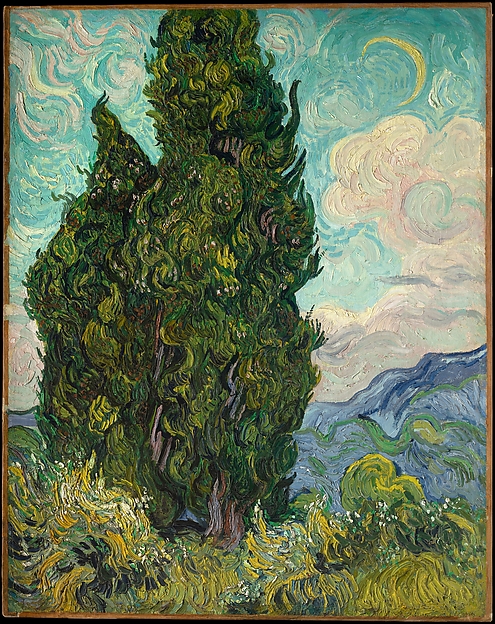
A landscape can contain a tree without making the tree feel like a subject. It can provide scale, shade or a convenient border for a distant view. In Van Gogh’s Cypresses, the dark vertical mass refuses that supporting role. It interrupts the sky and occupies a share of the surface that the surrounding brightness cannot easily push aside.
The Metropolitan Museum of Art dates the painting to 1889 and records its medium as oil on canvas. Its dimensions are 93.4 by 74 centimetres. The museum places its making in late June, at Saint-Rémy, and discusses the challenge the dark trees presented within a sunlit landscape. [1] This is enough context to begin looking without making the picture an illustration of the artist’s entire life.
Start at the outer edge of the cypresses. The boundary is active rather than evenly clipped: dark and light shapes meet in a sequence of turns. Follow the edge upwards, then move your attention into the sky. The change is not from movement to stillness. The surrounding air is also organised through conspicuous painted marks.
That shared activity complicates a simple division between a solid tree and an empty atmosphere. The sky does not disappear behind the object as neutral space. It answers the tree with its own curves. You can read the composition as a negotiation between differently coloured areas that are nevertheless worked with related kinds of energy.
Now look towards the lower part of the painting. Lighter vegetation and the ground establish a different pace from the tall central growth. The eye moves sideways before being pulled upwards again. A reproduction that crops away this lower passage can preserve the recognisable cypresses while weakening the sequence by which the painting brings you to them.
Calling the tree dark is only a first approximation. Within the mass, small shifts of colour and direction prevent it from behaving like a single flat cutout. In this digital image, some of those distinctions are easier to notice than others. A screen cannot establish the full surface, gloss or thickness of the physical paint.
There is a temptation to make every twisting stroke carry an emotional diagnosis. The painting becomes proof of a troubled mind before its visible decisions have been described. Biography can matter, but a dark passage or a curved mark does not diagnose anyone. A more responsible sentence begins with what the mark does within this particular picture.
For example: a strong upward rhythm keeps returning attention to the tree. Or: the bright field makes the dark area more insistent. These are interpretations of visible relations. They can be disputed by pointing to the painting, which makes them more useful than a psychological claim that the image alone cannot verify.
The tree’s scale also changes with the scale of the reproduction. On a small screen, it can become a compact emblem. At a larger size, separate marks begin to compete with the overall silhouette. Try viewing the whole image, then one enlarged section, and note which relationships survive the change.
One practical exercise is to sketch only three connected areas: the dark cypresses, the light sky and the lower ground. Do not copy individual strokes. Decide where each area presses against another. The exercise reveals how much of the composition works before recognisable botanical detail enters the drawing.
The title names a kind of tree, but the painting gives it a role: an interruption that makes the surrounding light legible. You need not choose between appreciating the subject and attending to the material organisation of the image. The tree is compelling because it can be both vegetation and a problem worked out in paint.
Original visual criticism by Odd Index, based on the museum’s digitised work. No firsthand examination of the canvas is claimed. For another way of reading movement across an image, continue with our essay on Hiroshige’s rain.
Sources & further reading
- [1] The Metropolitan Museum of Art — Vincent van Gogh, Cypresses, 49.30: date, medium, dimensions, context and public-domain image. https://www.metmuseum.org/art/collection/search/437980
- Image policy: The Met Open Access. https://www.metmuseum.org/policies/image-resources
Source records checked 2026-10-16. Original editorial text by Odd Index; image rights are stated in the caption.
Read next
 Art / Print criticism · Free to read
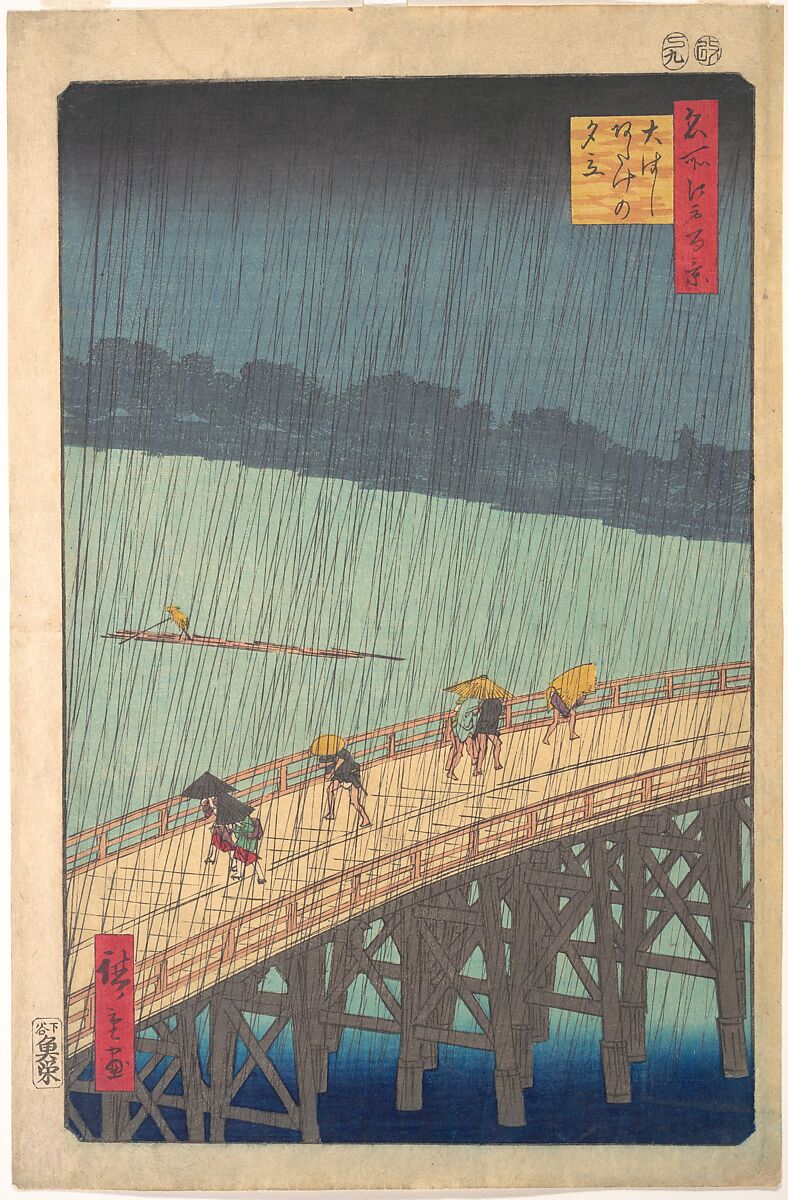
Hiroshige’s Rain Has Two Directions
A bridge, a field of fine rain lines and small hurrying figures: how one woodblock print makes weather a bodily problem.
Read the essay ↗ Art · Free to read
How to Look at Hokusai’s Great Wave
The famous crest is only one part of the picture. Follow the boats, the small mountain and the edge of the paper.
Read the essay ↗Visual culture · Free to readHow to Read a Museum Label Without Losing the Artwork
Separate what you see, what the collection record states and what you infer. A practical method for your next visit.
Read the essay ↗