Art / Free essay · 2026-10-16
How to Look at Hokusai’s Great Wave
The famous crest is only one part of the picture. Follow the boats, the small mountain and the edge of the paper.

The easiest way to miss Hokusai’s Great Wave is to recognise it immediately. A curling blue crest appears and the eye supplies the rest: Japan, a famous print, something seen on a poster. Recognition feels like understanding because it happens so quickly. Try staying with the image after its name has arrived.
Begin with the boats. They are long, narrow shapes pressed into the lower part of the composition, and their occupants repeat in small bent forms. Set the wave aside for a moment and follow these horizontal passages across the picture. The people are not decorations added to a seascape. Their presence gives the surrounding water a scale that a crest alone could not provide.
Now find Mount Fuji. Its small pale triangle sits inside the opening beneath the great curve. The Metropolitan Museum of Art describes Hokusai’s play with perspective: the mountain appears small within the hollow of the wave. [1] A distant fixed form and a nearer unstable one share the picture, but they ask to be looked at in different ways.
That difference is more interesting than deciding whether the scene is simply beautiful or terrifying. The mountain offers a shape the eye can complete. The foam keeps interrupting its own outline. Follow a single curling edge and notice how quickly it breaks into smaller projections. The image can feel both clearly organised and difficult to settle.
The museum dates this impression to about 1830–32 and identifies it as a woodblock print in ink and colour on paper, from Thirty-six Views of Mount Fuji. Its recorded dimensions are 25.7 by 37.9 centimetres. [1] Those measurements are worth holding beside a screen. An image that has become culturally enormous is still encountered through particular sheets of paper.
That does not make a large reproduction wrong. It makes it a different encounter. A wall-sized version lets the crest surround you. A smaller sheet asks you to lean closer. A phone image lets your thumb cover a boat. Before comparing your reaction with someone else’s, ask what size and kind of object each of you was actually looking at.
Try covering the upper third of the reproduction with a piece of plain paper, without touching an original artwork. What remains is a compressed field of hulls, bodies and water. Remove the paper, then cover the boats instead. The crest has not changed, but the picture’s invitation has. This is a looking exercise, not a reconstruction of the artist’s intention.
Colour introduces another set of decisions. Look for where blue defines an edge and where an unprinted-looking light area carries the shape instead. Resist turning every detail into a code with one correct meaning. You can describe a boundary, contrast or repetition precisely without claiming to know what every mark symbolises.
The full title also slows down the familiar shorthand. Under the Wave off Kanagawa names a location and a relationship; The Great Wave turns that relationship into an icon. Neither title is useless. But placing them side by side can reveal how a widely reproduced image becomes detached from some of the information carried by its collection record.
A useful note after looking contains three things: a detail you can point to, a fact you checked, and a question that remains open. For this print, the detail might be a line of bent bodies; the checked fact might be the sheet’s dimensions. The open question might concern how scale changes your reading of the wave.
None of this requires pretending the print is unfamiliar. Its recognisability is part of the experience now. The task is to let familiarity become a starting point rather than a stopping point. The next time you meet the crest on a tote bag, you may find yourself looking for the boats that the crop has left out.
Original visual analysis and observation exercises by Odd Index. This article discusses the museum’s digitised impression; it does not claim a firsthand viewing of the physical print.
Sources & further reading
- [1] The Metropolitan Museum of Art — Under the Wave off Kanagawa, JP1847. Date, medium, dimensions, perspective and public-domain image record: https://www.metmuseum.org/art/collection/search/45434
- Image use: The Met Open Access / public domain. https://www.metmuseum.org/policies/image-resources
Source records checked 2026-10-16. Original editorial text by Odd Index; image rights are stated in the caption.
Read next
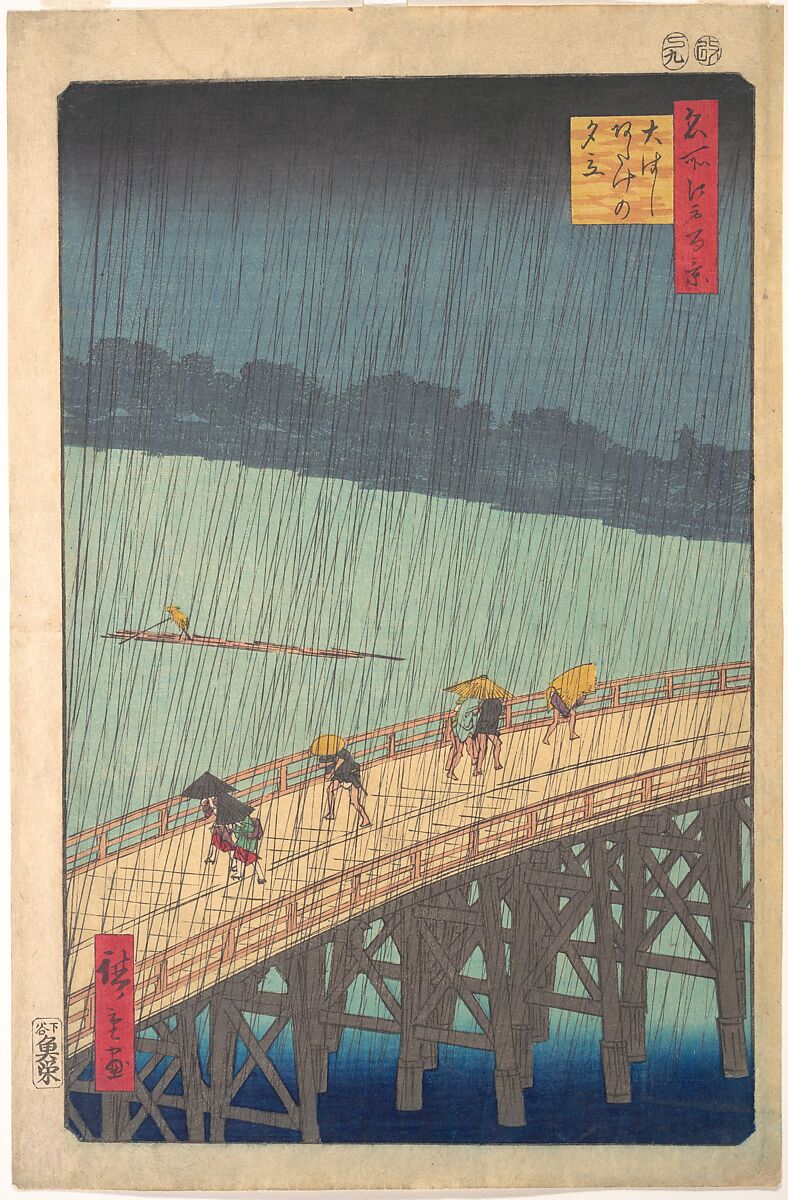 Art / Print criticism · Free to read
Hiroshige’s Rain Has Two Directions
A bridge, a field of fine rain lines and small hurrying figures: how one woodblock print makes weather a bodily problem.
Read the essay ↗Visual culture · Free to readHow to Read a Museum Label Without Losing the Artwork
Separate what you see, what the collection record states and what you infer. A practical method for your next visit.
Read the essay ↗Moss & Orbit · Field dossier · Member previewHow to Read a Specimen Without Inventing Its Story
A close-reading dossier with a reusable worksheet for labels, gaps and observation.
Read the preview ↗