Visual culture / Free essay · 2026-10-16
How to Read a Museum Label Without Losing the Artwork
Separate what you see, what the collection record states and what you infer. A practical method for your next visit.
You walk up to an artwork and immediately turn towards its label. A few seconds later, you know a date, a name and an interpretation, but you have barely looked at the thing beside it. The label has done its job so efficiently that it has become the encounter. A different sequence can make both the writing and the work more useful.
Begin with a short period of looking before reading. There is no ideal number of seconds. Find one detail you could point out to another person: a joint, an edge, a repeated colour, a gap. “It feels sad” may be a real response, but “the figure occupies a narrow strip at the bottom” gives the conversation something visible to return to.
Then read the basic record. Ask what kind of information each field supplies. A title names the work or the museum’s way of referring to it. A date locates its making, sometimes approximately. A medium describes materials or process. Dimensions tell you about an object that a photograph may have made difficult to imagine.
Keep small qualifications intact. The word “about” is not decorative. Brackets are not necessarily part of an artist’s chosen title. If a record leaves something uncertain, your notebook should not silently turn it into a certainty. Copying less information accurately is better than collecting a fuller set of claims you have accidentally strengthened.
Consider two actual museum records. The Met lists Hokusai’s Under the Wave off Kanagawa at about 1830–32 and 25.7 by 37.9 centimetres. It lists Talbot’s Botanical Specimen at about 1835, with an irregularly trimmed sheet measuring 18.8 by 11.3 centimetres. [1][2] Both images travel easily across screens. Their recorded objects occupy very different amounts of space.
Now return to the artwork with one field in mind. If you have just read the material, inspect where that material becomes visible. If you have read the dimensions online, imagine or measure a comparable rectangle on scrap paper. The record becomes useful when it sends your attention somewhere more specific than “this is important”.
Treat an interpretive paragraph as a proposal to examine. Which visible feature supports its claim? Does it introduce a historical fact that needs a source, or describe a relation you can test by looking? You do not have to agree with every reading, but disagreement becomes more interesting when it identifies what the explanation notices or overlooks.
A compact notebook can use three headings: Seen, Stated, Inferred. Under Seen, describe the detail you observed. Under Stated, write the museum’s information and where you found it. Under Inferred, put your own reading. The headings are an editorial exercise, not a universal museum standard; their value lies in keeping different kinds of statement from blending together.
Imagine a chair presented on a platform. “Black frame and coloured planes” might belong under Seen. A collection date belongs under Stated. “The display makes the chair feel distant from ordinary use” belongs under Inferred. The last sentence can be worth writing without pretending that it is an archival fact.
A credit line introduces a further question: how did this object enter this collection? Record what the line actually says before inventing a story around it. A gift, purchase or bequest is a piece of collection information, not by itself a complete account of ownership, consent or the circumstances of every earlier transfer.
For an online visit, preserve the link to the exact object record rather than only a screenshot. The record may contain a qualification that disappears when an image is reposted. Your own notes can also identify which version you consulted. The articles linked below include museum records so that a reader can retrace these steps.
Finish by looking once more without reading. What is now visible that was not visible at first? What has the label not resolved? A good encounter does not end when the writing has supplied an answer. It can end with a more precise question, attached to a detail you can still find. This is an original practical guide by Odd Index.
Sources & further reading
- [1] The Metropolitan Museum of Art — Hokusai, Under the Wave off Kanagawa, JP1847: https://www.metmuseum.org/art/collection/search/45434
- [2] The Metropolitan Museum of Art — Talbot, [Botanical Specimen], 2005.100.840: https://www.metmuseum.org/art/collection/search/283063
Source records checked 2026-10-16. Original editorial text by Odd Index; image rights are stated in the caption.
Read next
 Art · Free to read
How to Look at Hokusai’s Great Wave
The famous crest is only one part of the picture. Follow the boats, the small mountain and the edge of the paper.
Read the essay ↗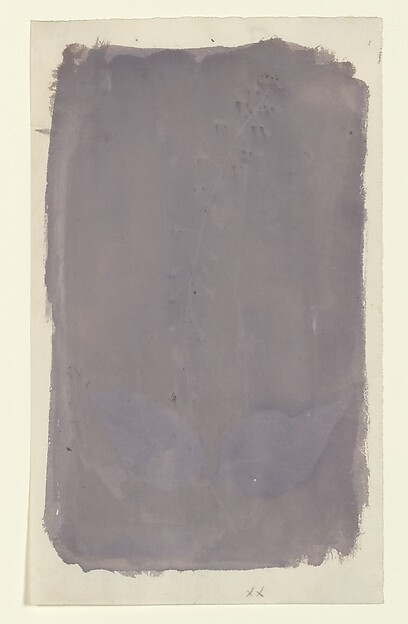 Art · Free to read
What Is a Photogram? A Plant Without a Camera
Talbot’s botanical specimen makes a photograph through contact and absence. Here is what that changes about looking.
Read the essay ↗Moss & Orbit · Field dossier · Member previewHow to Read a Specimen Without Inventing Its Story
A close-reading dossier with a reusable worksheet for labels, gaps and observation.
Read the preview ↗