Art / Print criticism / Free essay
Hiroshige’s Rain Has Two Directions
A bridge, a field of fine rain lines and small hurrying figures: how one woodblock print makes weather a bodily problem.
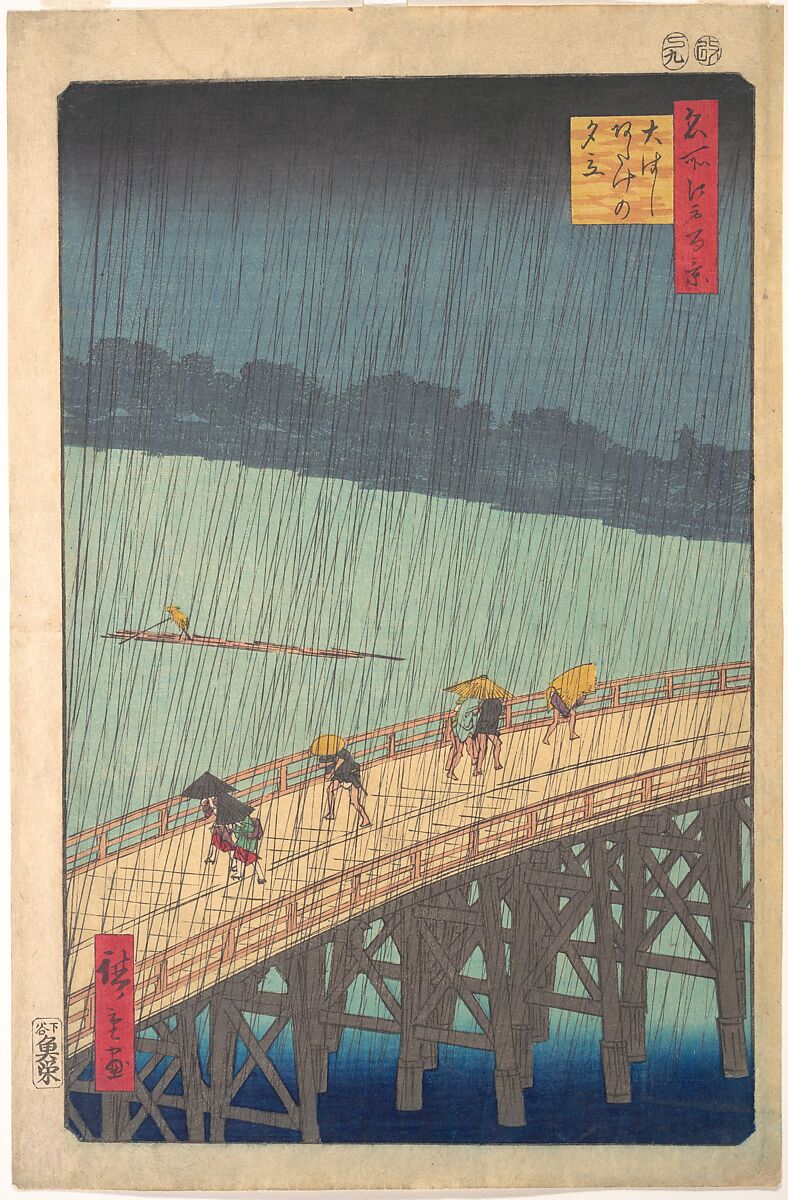
In Hiroshige’s Sudden Shower over Shin-Ōhashi Bridge and Atake, the rain reaches you before the people do. Thin diagonal strokes cross the print in a dense field. The bridge supplies another diagonal, broader and more solid. One kind of line tells you what the weather is doing; the other tells you where a body might go.
The Metropolitan Museum of Art dates this colour woodblock print to 1857 and identifies it as part of One Hundred Famous Views of Edo. The reproduction discussed here is the museum’s impression JP3174, which it marks as public domain. This is close looking at that digital image, not a report of seeing the original on display. [1]
Look at the bridge before following its pedestrians. It cuts across the lower part of the upright sheet, so that the route through the scene never settles into a comfortable horizontal. Your eye has a direction to travel. The rain cuts across that direction, interrupting it without removing it. The picture produces resistance using marks that occupy almost no thickness.
That resistance becomes bodily in the small figures. Umbrellas and coverings change their outlines; bent postures make the weather legible at the scale of a person. These silhouettes do not need portrait detail to create a situation. You can recognise the adjustment of a body to rain without knowing anybody’s name, occupation or destination. Those biographies would be inventions, not discoveries in the print.
The river offers a different pace. Its broad coloured area has less internal busyness than the bridge. Across it, the distant bank loses definition beneath the dark sky. Near movement and far uncertainty coexist. The composition gives the eye somewhere to rest, but the rest does not feel safe from the weather.
This is also a useful distinction between drawing rain and drawing wetness. The diagonal strokes make falling rain visible. The figures suggest what that rain asks people to do. Neither device has to describe every drop, every reflection or every damp surface. Their combination lets a relatively economical image feel eventful.
The Met’s commentary on another impression of the design describes the crisscrossing rain pattern as a difficult woodblock technique. [2] That matters because the apparently instantaneous shower was produced through a worked printing process. The weather looks sudden; the image of it required decisions that could be repeated. We should not confuse the speed of the depicted event with the speed of its manufacture.
Our critical reading is that the print depends on a controlled disagreement. The bridge promises passage, while the rain makes that passage inconvenient. The large planes keep the scene readable, while the fine lines make it unsettled. Remove the bridge’s angle and the journey loses force. Remove the rain and the same people become much harder to read as a shared moment.
There is a limit to what this reading can establish. A reproduction’s colour depends on the particular impression, the photography and your screen. It cannot settle how this sheet feels as paper or how its ink looks in person. Nor does a strong compositional effect prove an exact intention in the artist’s mind. What we can describe is the relationship between visible elements in this image.
For an illustrator or designer, the useful lesson is not to borrow a Japanese bridge and call the result atmosphere. It is to assign different jobs to different marks. A heavy shape can establish a route. A repeated fine line can impose a condition. A small change in a figure can show the consequence. Decoration becomes more compelling when its elements make each other necessary.
Try returning to the image after hiding the title. Follow the bridge with your eyes, then follow the rain. Notice where those movements disagree. Finally look at one figure and ask which visible detail makes the weather matter to it. The print holds attention because a landscape has become something people must negotiate, one crossing at a time.
Sources & further reading
- [1] The Metropolitan Museum of Art, Utagawa Hiroshige, Sudden Shower over Shin-Ōhashi Bridge and Atake, 1857, JP3174. Object record and public-domain reproduction; checked 14 October 2026. https://www.metmuseum.org/art/collection/search/37386
- [2] The Metropolitan Museum of Art, another impression of the same design, JP2522: curatorial commentary on the rain pattern and woodblock technique; checked 14 October 2026. https://www.metmuseum.org/art/collection/search/55433
- Further looking: compare the two museum impressions before treating a screen colour as a fixed property of the design. This essay’s compositional judgments are Odd Index’s visual interpretation, not claims about the artist’s documented intentions.
Read next
 Objects · Free to read
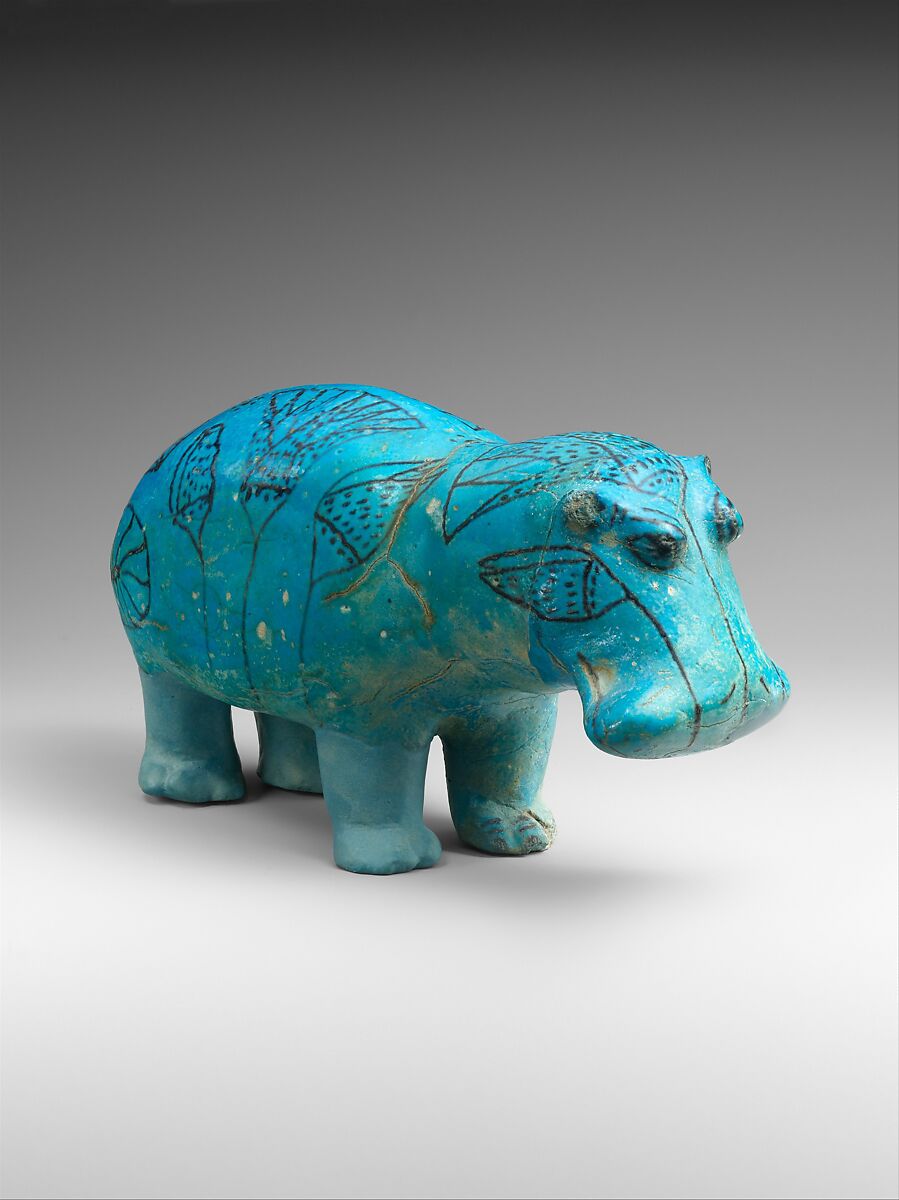
The Blue Hippo Carries More Than a Pattern
William’s lotus-covered body is at once an animal, a landscape and a repaired object. Its friendliness is the beginning of a reading, not the end.
Read the essay ↗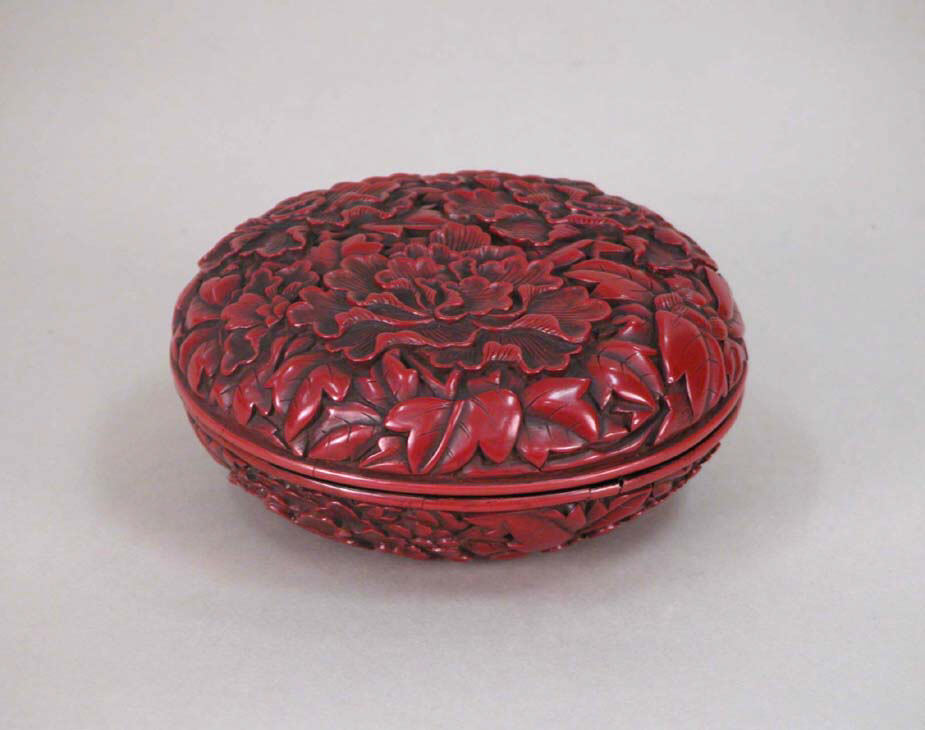 Material Histories · Free to read
Lacquer: A Surface Made of Time
A carved red box reveals why a finish is not merely the last step: building a surface can create the material from which ornament is cut.
Read the essay ↗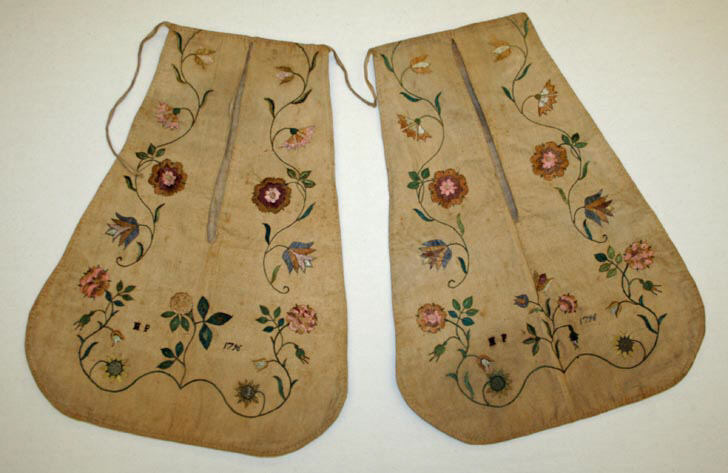 Dress & Power · Free to read
A Pocket Is a Question of Access
A detachable eighteenth-century pocket complicates the story that women simply had no useful storage. Look at the opening, the tie and the route of the hand.
Read the essay ↗