Objects / Free essay · 2026-10-16
The Teapot That Makes Pouring Look Like Engineering
Christopher Dresser’s silver-plated teapot turns handles, joints and empty space into an argument about design.
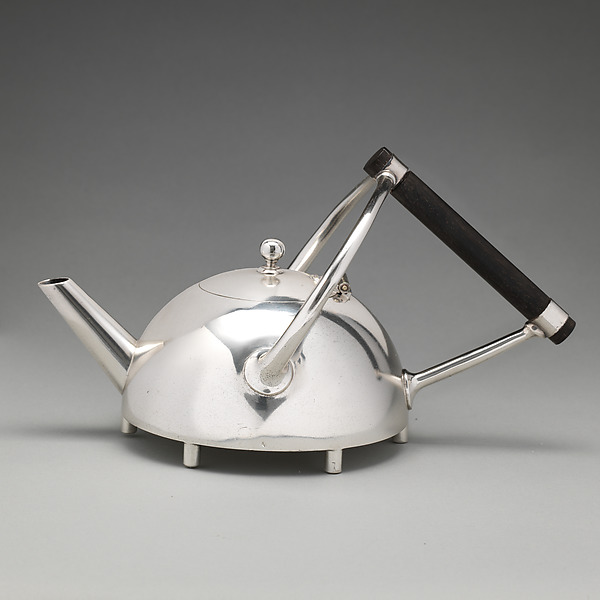
Some teapots let their handle merge into the body as an ornamental curl. This one makes the handle look like a structure assembled around a vessel. A dark grip sits between bright metal members. The body is low and rounded, the spout sharply directed, and small feet lift the whole object just clear of the surface.
The Metropolitan Museum of Art identifies the design as Christopher Dresser’s and the manufacturer as James Dixon & Sons. It dates the object to about 1879 and lists silverplate and ebony as its materials. [1] Those basic fields already suggest several kinds of work: designing a form, making it, and combining materials with different visible qualities.
Look at the empty triangular area associated with the handle. It occupies no solid volume, yet it is one of the strongest shapes in the photograph. Design here includes the organisation of a gap. The metal supports outline space and ask the eye to complete a structure that the vessel itself does not fill.
The dark grip produces a useful contrast. In this reproduction, it reads differently from the bright body and supports. We can say that the materials have been visually distinguished. We cannot establish from the photograph alone how the grip feels, how hot it becomes or how comfortably a particular person can hold it.
This distinction matters because an unusual object invites an unusually quick verdict. It looks practical, or it looks impractical; it looks ahead of its time, or it looks awkward. Each verdict can arrive before the viewer has considered what information would actually be needed to test pouring, cleaning, balance or temperature.
Trace an imagined movement from the grip towards the spout. Where would the vessel tilt? What would have to remain secure? Treat these as questions prompted by the image, not proof of successful engineering. A photograph can make a mechanism intelligible without demonstrating its performance.
The small feet introduce another relation. They separate the curved body from the table and expose a narrow interval beneath it. Their repetition also makes the base seem deliberately placed rather than simply resting wherever the vessel’s curve meets the ground. A small detail changes how the larger mass appears to stand.
The museum describes the teapot as one of Dresser’s unusual designs and notes a tension with his own principles concerning economical production and expensive materials. [1] That tension is more useful than treating the object as an uncomplicated prediction of modern design. A forceful shape can express an ambition without resolving every condition of manufacture.
Designer and manufacturer should also remain separate in the account. A famous name can make the object appear to have sprung fully formed from one imagination. The collection record gives a second name because production belongs to the object’s history. The record does not, however, supply the identities of every person who worked on this particular piece.
Set an ordinary teapot beside the reproduction, if you have one. Compare three things only: where your hand goes, how the lid meets the body, and what supports the vessel. You need not decide which is more beautiful. The comparison makes familiar solutions visible, which is often a better beginning than ranking designs.
An object like this rewards attention because it places the ordinary activity of pouring under visual pressure. You notice that a handle is not inevitable, that a connection can be displayed, and that empty space can become part of an object’s identity. Whether it pours well remains a question for an actual test.
Original design criticism by Odd Index. The object discussed is the Met’s teapot, not another Dresser design or a modern reproduction. No handling, thermal or pouring test has been performed.
Sources & further reading
- [1] The Metropolitan Museum of Art — Christopher Dresser / James Dixon & Sons, Teapot, 2021.153.2: attribution, date, materials and production context. https://www.metmuseum.org/art/collection/search/823191
- Image policy: The Met Open Access. https://www.metmuseum.org/policies/image-resources
Source records checked 2026-10-16. Original editorial text by Odd Index; image rights are stated in the caption.
Read next
 Objects · Free to read
The Chair That Wants to Be Looked At
Rietveld's Red Blue Chair makes a useful starting point for asking what we expect furniture to do.
Read the essay ↗ Objects / Design criticism · Free to read
The Tiffany Lamp That Kept Its Oil Tank
A peacock-glass shade, a surviving kerosene reservoir and an electric attachment complicate the story of modern lighting.
Read the essay ↗Visual culture · Free to readHow to Read a Museum Label Without Losing the Artwork
Separate what you see, what the collection record states and what you infer. A practical method for your next visit.
Read the essay ↗